


Add It Up: Understanding ROI Factors for Sorting Transfer Robots (SOTR) — SOTR‑S & SOTR‑L
Guest Blog from MHI Member Daifuku
Automation continues to reshape warehouses and distribution centers, driven by the need for speed, accuracy, and adaptability. Among the technologies gaining traction are sorting transfer robots (SOTRs)—systems designed to streamline how items move through facilities. This article looks at what these systems do, how they work, and the broader ROI considerations involved when evaluating automated material handling solutions.
Sorting Transfer Robots: What They Are and How They Work
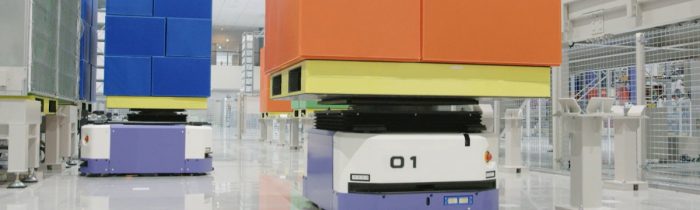
A sorting transfer robot (SOTR) is an automated system that uses mobile vehicles equipped with load‑transfer mechanisms to move items to designated locations throughout a facility. These robots typically operate within a Warehouse Execution System (WES), which coordinates traffic, manages locations, and oversees load retrieval and delivery.
Here’s a simplified breakdown of how they operate:
- Scanning and identification
Scanners or smart cameras read barcodes or other identifiers to determine where an item belongs. - Load transfer
The item is placed onto a robot’s transfer platform. - Transport and delivery
The robot travels to the assigned chute, tote, bin, or load stand and deposits the item. - Repeat cycle
Once a load is delivered, the robot is routed to its next pickup point.
Different SOTR models exist to support various load sizes—from small parcels to full pallets—making the technology adaptable to a range of applications.
Key Operational Advantages
SOTRs replace repetitive manual sorting tasks that are often time‑consuming and prone to error. By performing this work autonomously and continuously, they can help organizations address labor shortages, improve handling accuracy, and reduce variability in day‑to‑day operations.
Other operational advantages include:
• Higher throughput
Robots can process large volumes of items more consistently than manual approaches.
• Scalability
Additional robots or sorting destinations can be added during peak demand periods and reduced when volumes normalize.
• System integration
SOTRs can be part of a larger automated workflow alongside technologies such as AS/RS systems, case‑picking robots, or AGVs.
Understanding the SOTR-S and SOTR-L
SOTR‑S
The SOTR‑S is designed for high‑speed piece sorting in environments with dense layouts. Its vehicles can travel at high speeds in a two‑tier structure, and the system can process up to 10,000 lines per hour.
A few notable characteristics:
• Compact footprint compared with many conventional sorting systems
• Narrow aisles enabled by a tilting tray mechanism
• Ability to expand capacity by adding more vehicles or chutes
• Straightforward integration into existing facilities
SOTR‑L
The SOTR‑L is geared toward pallet‑level sorting and transport. It supports loads up to 1,000 kg and is suited for manufacturing and distribution environments where pallet movement is a core function.
Key characteristics include:
• No need for fixed tracks or conveyors, which helps free up floor space
• Scalability for changing volume demands
• Strong integration potential with systems such as AS/RS or case‑picking solutions
• Available variations (e.g., SOTR‑M) to handle smaller loads like totes and cases
How Automated Solutions Influence ROI
Evaluating the return on investment for automation involves a variety of operational and financial considerations. While SOTRs may be just one component of a broader automation strategy, their flexibility can make adoption more manageable compared with fully fixed systems.
Here are several factors commonly used when calculating ROI:
- Space Utilization
Systems like AS/RS and mobile transfer robots can help facilities maximize vertical and horizontal space. With warehouse construction costs climbing—often reaching well over $100 per square foot—optimizing existing space is often more cost‑effective than building new structures.
- Inventory Shrinkage
Automation reduces the likelihood of misplaced, damaged, or lost goods. Real‑time tracking can help identify issues earlier and minimize losses.
- Safety and Ergonomics
Many injuries in industrial environments stem from repetitive or high‑risk manual tasks. Automated systems can help remove operators from these zones, contributing to a safer workplace and reducing downtime linked to injuries.
- Data Visibility
Automated systems generate detailed, real‑time data. This visibility can improve decision‑making, identify bottlenecks earlier, and support continuous improvement initiatives.
- Operational Efficiency
Automation can increase picking accuracy, reduce travel time, and accelerate key processes. These incremental gains—multiplied across thousands of daily tasks—often contribute significantly to ROI over time.
Putting It All Together
SOTR technologies, along with other automated material handling systems, are becoming increasingly central in modern warehouse and distribution operations. Their ability to integrate, scale, and adapt makes them useful building blocks for organizations seeking to enhance productivity without committing to rigid infrastructure from day one.

