


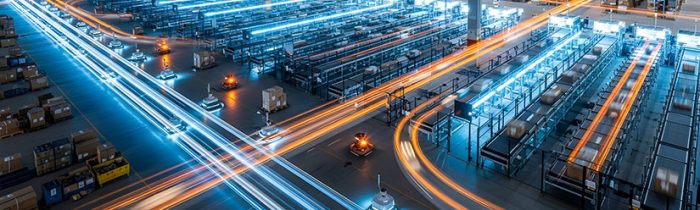
AI and Robotics: Powering the Next Generation of Supply Chains
Guest blog by MHI member FORTNA
Supply chains are the backbone of today’s economy. When supply chains operate smoothly, goods move predictably, shelves remain stocked, customers receive orders on time and costs stay under control.
But when supply chains break down, disruption spreads quickly. Delayed shipments, inventory shortages and operational bottlenecks ripple across industries, ultimately impacting consumers and your bottom line. In today’s volatile environment, supply chain leaders must balance efficiency with resilience.
In honor of National Supply Chain Day, this insight explores the forces that are reshaping supply chains in 2026 and the technologies helping organizations build more agile operations. Learn how strategic network design, automation, artificial intelligence (AI) and robotics are transforming supply chain performance to move from reactive to resilient operations.
The forces reshaping supply chains today
Supply chains are operating at the intersection of volatility and acceleration. While organizations face ongoing economic pressure and workforce constraints, customer expectations for speed and transparency continue to rise.
According to the MHI Annual Industry Report,¹ the top company-level challenges include:
· Talent acquisition and workforce challenges (58%)
· Accurate forecasting and inventory management (48%)
· Meeting evolving customer demands (46%)
These challenges rarely occur in isolation. Labor shortages complicate fulfillment speed. Inaccurate forecasting increases inventory volatility. Growing customer expectations require faster fulfillment capabilities. Together, these forces create operational complexity across all stages of the supply chain. As a result, incremental improvements are no longer enough.
This is where a strategic, integrated approach becomes critical. By aligning best-fit technology with operational goals, this empowers companies to increase throughput, improve visibility, reduce labor dependency and build supply chains that can adapt to changing demand.
Organizations that fail to take this holistic approach risk falling behind as operational complexity continues to grow. To build seamless supply chains, leaders must address the most pressing challenges that are shaping the industry today.
Top supply chain challenges in 2026
The top supply chain challenges in 2026 include labor shortages, demand forecasting complexity, rising customer expectations and increasing geopolitical and regulatory uncertainty. These pressures are driving organizations to modernize and invest in automation, AI and integrated supply chain strategies to remain competitive.
Next, take a closer look at the biggest supply chain challenges and the strategies leading organizations are using to overcome them.
1. Labor shortages and workforce retention
Labor scarcity remains one of the most significant operational risks in supply chain operations. The U.S. warehouse labor deficit is projected to expand by an additional 6 million workers by 2032,² further intensifying competition for skilled workers. At the same time, warehouse turnover rates average approximately 43%,³ among the highest across industries.
Manual processes simply can’t keep pace with growing order volumes and service expectations. To address the labor shortage challenge, organizations are increasingly turning to warehouse automation and robotics to augment human labor. Automation allows workers to focus on safer, higher-value tasks while robots and machines handle repetitive and physically demanding activities such as transport, picking and sorting. By deploying automation into optimized workflows, companies can increase productivity while reducing reliance on manual labor.
2. Demand forecasting and data silos
Many organizations collect vast amounts of operational data. However, without integrated systems to interpret and act on that information, valuable insights remain trapped in disconnected platforms. This fragmentation of data limits visibility, adds complexity and slows decision-making.
End-to-end supply chain orchestration addresses this challenge by connecting forecasting, planning, inventory management and warehouse operations into a unified framework.
When organizations leverage advanced analytics, AI and machine learning within an integrated platform, they can quickly analyze large datasets and generate actionable insights. Supply chain leaders can respond faster to demand shifts, optimize inventory levels and improve operational performance.
3. Rising customer expectations and omnichannel complexity
Consumers now expect same-day or next-day delivery, near-perfect accuracy and real-time visibility from click to doorstep. Simultaneously, organizations often need to support several fulfillment channels, including e-Commerce, retail replenishment and direct-to-consumer distribution. Each additional channel introduces new expectations, packaging requirements and fulfillment workflows. This shift creates pressure in several key areas:
· Compressed fulfillment windows
· Higher order variability
· Increased SKU proliferation
· Real-time visibility expectations
· Reverse logistics growth
Manual processes struggle to keep pace with this level of speed, precision and complexity. Warehouse robotics, AI and automation technologies are foundational to meeting customer expectations at scale.
Robotic technologies like autonomous mobile robots (AMRs) and automated storage and retrievals systems (AS/RS) enable goods-to-person workflows that reduce travel time, improve picking accuracy and increase throughput. AI-powered platforms dynamically prioritize orders, adjust workflows during demand fluctuations and predict bottlenecks before they impact service levels. Together, these technologies allow organizations to meet aggressive delivery commitments without proportionally increasing labor costs.
4. Geopolitical risk and regulatory changes
Global supply chains are increasingly exposed to geopolitical instability, shifting trade policies and evolving regulatory requirements. These external factors create uncertainty across sourcing, transportation and inventory strategies.
Resilient organizations are designing supply chains that can adapt quickly to changing conditions. This requires flexible systems such as:
· Modular automation systems that scale without full redesign
· Reconfigurable warehouse layouts
· Software-driven workflows that can be optimized in real time
· AI-powered scenario modeling
Rather than relying on static processes and infrastructure, modern supply chains with automation technologies can dynamically adjust storage strategies, picking workflows and throughput levels as conditions evolve. AI and machine learning models are playing an increasingly important role in this adaptability by analyzing data to detect emerging risks early and recommending corrective actions before disruptions escalate.
From reactive to resilient: transforming supply chains with AI and robotics
Advanced technologies are enabling organizations to operate with greater speed and flexibility, even as supply chain complexity increases. Robotics, AI and other advanced supply chain technologies equip companies to process massive datasets faster and simulate operational scenarios, optimizing performance in real time.
AI in supply chains: smarter decisions at scale
Artificial intelligence expedites how supply chains plan, predict and optimize operations. According to the MHI report:¹
· 41% of organizations currently use AI
· 47% plan to implement AI within the next five years
AI is not replacing human expertise; it is enhancing it. By combining human decision-making with predictive analytics, organizations gain faster insight into complex operational conditions. Teams can simulate scenarios, test strategies and optimize workflows before implementing physical changes.
This ability to anticipate disruptions rather than react to them represents a fundamental shift in supply chain management. Embedding AI into operations can help companies accelerate to meet the increasing demands of consumers.
Robotics in warehousing: the execution engine
While AI provides intelligence, robotics provides execution at scale. Just like AI, robotics adoption continues to increase across distribution networks.
According to the MHI report¹:
· 35% of organizations currently use robotics and automation
· 38% plan to implement robotics and automation within the next 5 years
Robotics and automation reduce dependency on manual travel time and repetitive tasks, enabling goods-to-person workflows that dramatically increase operational efficiency. Unlike traditional fixed automation, modern robotics solutions are modular and scalable. In fact, organizations can increase capacity without a complete system redesign or needing to expand their facility footprint.
Advanced warehouse automation drives measurable gains in:
· Throughput and order fulfillment speed
· Picking accuracy and quality control
· Storage density and space utilization
· Worker safety and ergonomics
· Scalability for fluctuating and growing demand
When AI & robotics operate together, performance gains multiply. AI accelerates decision-making, optimizes workflows and predicts constraints, while robotics executes tasks with precision and consistency. Together, they create intelligent fulfillment environments capable of adapting to demand fluctuations and operational disruptions.
Why integration is the differentiator
Technology alone does not guarantee results. Real transformation occurs when AI, robotics and warehouse automation are engineered as part of a unified, end-to-end supply chain strategy.
This is where integration expertise becomes critical to bringing together complex systems into a unified operational ecosystem, providing seamless integration between robotics, automation technologies and intelligent software. By ensuring that technologies communicate, share data and operate within optimized workflows, this can unlock the full performance potential of supply chain investments.
In an era defined by uncertainty, scalability and speed, organizations need supply chains designed to anticipate disruption, adapt to change and deliver consistent performance under pressure. The companies that succeed are building intelligent, flexible, fully integrated supply chain ecosystems that evolve for today’s goals and tomorrow’s growth.
Sources:
1 https://www.mhi.org/annual-industry-reports
2 https://www.scmr.com/paper/close-the-warehouse-labor-gap-with-overlooked-talent-pools
3 https://www.speedcommerce.com/insights/warehouse-statistics-comprehensive-industry-data/

