


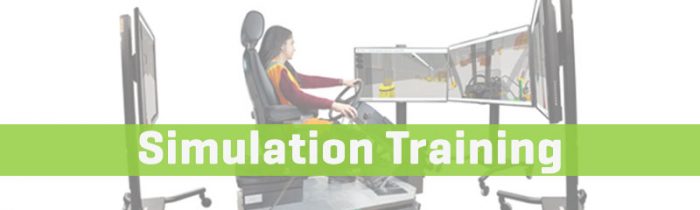
How to Reduce Workforce Turnover and Improve Employee “Retention” with Simulation Training
Guest blog by Paul Freedman, PhD, P.Eng, President and Founder of Simlog (MHI Member)
The Workforce Turnover Problem
Companies in all sectors, including logistics, continue to face workforce challenges [1]. What’s typically measured is workforce turnover, i.e. the percentage of your permanent workforce that you “replace” each year.
Here are some turnover numbers from the Warehousing Education and Research Council’s (WERC) “DC Measures Report” for 2025 [2]
• best in class: 5% or less
• typical percentages: 15-20%
although some companies reported as much as 35%.
The report also makes clear that less turnover “reduces the burden of constantly hiring and training new employees.” And having a workforce with more longer-tenured operators also “means” better lift truck operations, as measured by greater efficiency and fewer disruptions [2].
The Costs of Workforce Turnover
The fact is, replacing someone can cost 30% or more of that worker’s annual salary [3], to take into account
• recruiting, and then hiring, someone new
• training that new person to become safe and “minimally” productive
• “dealing” with new operator mistakes (damage to equipment, merchandise loss)
• paying everyone else overtime
And that’s thousands of dollars.
These elements, of course, are the “tangibles”, but there are “intangibles” too: one person leaving can often “encourage” others to leave too. And in that way, over time, your company’s reputation as a “desirable” employer will suffer.
Everything Starts With Trainee Selection
Companies consistently tell us that trainees don’t “work out” for these three reasons:
• they drop out before the training ends because the work wasn’t what they thought it would be e.g. too physically demanding
• they’re asked (obliged) to leave before the training ends because they’re not learning well enough
• after the training ends, they’re just not doing well enough
In each case, your training investment is “lost”. If only you could choose a “better” person at the start, before training begins.
And that’s why it’s important to make better trainee selection an integral part of your training program [4].
The Key is Better Trainee Selection
The fact is, you need aptitude and attitude to become a proficient lift truck operator. And that’s why you want to be able to
• choose people to train who are truly “ready” to learn
• train those people better, in a way that helps them develop the necessary skills and self-confidence
And that’s because the consequences of improper training are costly (equipment is damaged, merchandise is lost, people are injured, sometimes tragically).
Indeed, some companies have also told us that newly-trained operators are responsible for two-thirds of equipment-related “incidents,” and three-quarters of those incidents occur within their first six months of work.
Fortunately, training simulation can help, to ensure that they will
• have the “ability” to do well
• continue to improve (without supervision) to reach the desired level of performance
Best in Class Simulator-Based Training is “Self-Managed”
The importance of simulation for training is now well recognized and the key is self-managed simulator-based training that meets the following three criteria:
1. Trainees can be all by themselves at the simulator, so they need (built-in) Instructional Videos to “explain” what to do.
2. Each trainee’s simulated work is evaluated (“scored”) in a comprehensive way, thanks to Performance Indicators that measure working carefully and working productively.
3. Trainees can monitor their own progress, by comparing their individual simulation results with target values (“benchmarks”) established by the employer.
In this way, training staff now work exclusively where they can most contribute, by helping people who have learned to do simulated work well enough “top up” in the real world.
Performance evaluation is truly objective, because
• everyone uses the very same training simulation exercises
• everyone’s simulated work is “scored” in exactly the same way.
And if your trainee can’t (or won’t) take the simulator-based training seriously enough to (eventually) achieve your company’s target values, well it’s time to consider someone else.
About the ROI of Simulator-Based Training
Of course adding a simulation “step” has to make sense financially and the simplest way to calculate Return on Investment (ROI) is to compare the costs of training with a real lift truck with the costs of training with a simulated lift truck.
Let’s begin in the real world, where we need to take into account the costs of
• having the lift truck (leasing costs)
• putting the lift truck to work (space require-ment costs, insurance costs, operating costs, maintenance and repair costs)
• having an instructor supervise the work (salary costs)
for a total amount that could easily exceed $100 per hour.
Here’s what a global automotive parts supplier in Kentucky, USA (and a long-time user of best in class simulator-based training), shared with us. Onboarding used to require one (long) day at the controls of a real lift truck (after two days of classroom “orientation”). And by “moving” the first half day (four hours) from the real world to the simulated world, the company “saved” $400, per person.
And because this company was onboarding hundreds of people every year, the price of adding the simulation “step” was “recovered” in just about one year.
Of course, at many other companies that are using best in class simulator-based training, trainees are spending 25-35 hours or more (so much more than 4 hours) to prepare for real work, and that would greatly increase the cost savings, and “speed up” the ROI.
Improve Retention with Cross-Training
With a new simulation “step” for onboarding new operators, it now becomes possible to use that same “step” for cross-training.
Here are some numbers from WERC’s “DC Measures Report” for 2025 [2] about cross-training:
• best in class: 90% or more
• typical percentages: 50-60%
although some companies reported as little as 20%.
Practically, cross-training lift truck operators means having someone ready to “step in” when someone else “steps away” (sick day, holiday, injury, etc.) and that, of course, reduces the burden on everyone else who would ordinarily need to work overtime.
In other words, a simulation step can help you increase cross-training and thereby reduce overtime hours as a percentage of total hours. And that, all by itself, will lower operational costs.
The Bottom Line
The fact is, you need attitude and aptitude and the right kind of training to address the employee retention problem that’s at the heart of the workforce turnover problem.
Fortunately, simulation can help you
• improve recruiting, by better choosing your training candidates
• onboarding new operators more safely and more cheaply
• reduce operating costs, by cross-training operators with simulator-based help, to be ready to “step in” when someone else “steps away.”
References
[1] B. McCrea, “Unpacking the Future of Warehouse Talent”, Material Handling Magazine, March 6, 2024.
[2] “DC Measures Report,” the Material Handling Institute’s Warehousing Education and Research Council (WERC), 2025.
[3] R. Bowman, “Is There a Solution to the Supply Chain Worker Shortage?”, Supply Chain Brain Blog, November 8, 2021.
[4] D. Ash, “Workforce Turnover Can Be Improved With Detailed Analysis”, ProMat 2025 Presentation, March 19, 2025.

