


Building a Smarter Shared Fleet: Three Container Decisions That Scale Across Complex Operations
Guest blog by MHI member Flexcon Container
Operating a large-scale distribution center or multi-client warehouse means managing a highly heterogeneous environment. Diverse product profiles, varied storage zones, and evolving automation platforms create immense physical complexity.
With up to 90% of supply chain leaders committing to heavy investments in automation technologies in recent data, the stakes for infrastructural reliability have never been higher. In these spaces, asking for a patchwork container solution is the wrong starting point. The strategic move is identifying which structural container decisions can be made once for an entire shared fleet, and which must inherently remain specific to the workflow.
Standardizing the Fleet You Control
A facility inherits container variance from inbound vendors and legacy asset pools, but internal standardization establishes a measurable baseline. The most impactful make-once decision is the exterior footprint. Consolidating to one or two master footprints streamlines conveyor guardrail widths, robotic gripper programming, and stacking parameters facility-wide. The only strict requirement is ensuring the chosen footprint divides cleanly into your standard shipping pallets (such as a 48 x 40 inch module), rack openings, and trailer floors without leaving dead air. Real estate is simply too expensive to waste your cubic volume on poorly fitted totes.
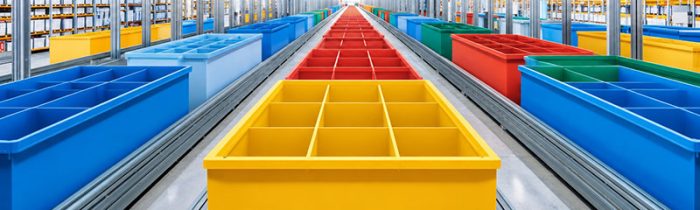
By deploying dividable containers, a single exterior footprint can support numerous interior configurations. Interlocking divider panels split the interior into secure, customized cells based strictly on geometry. Because these layouts can be reconfigured dynamically, one standardized exterior profile can seamlessly shift from housing micro-electronics to bulk industrial parts. This transient mechanical design prevents you from generating dead inventory of highly specialized, single-use totes just because a client profile changes, thereby eliminating the frictional drag of asset heterogeneity across your entire distribution network.
Validating Construction for Automation
Automation systems are entirely dependent on geometric consistency. While a human picker forgives a warped container wall, a robotic gripper or scan tunnel expects the exact same dimensional presentation every cycle. Day-one fit and service-life fit are two entirely different properties, meaning the container must survive years of heavy loads without breaching strict dimensional tolerances. Modern mini-load stacker cranes are unforgiving, operating at speeds of up to 3 meters per second, demanding a positioning accuracy of exactly 1 millimeter during extraction. If a crane’s extractor misses the tote’s edge condition by a fraction of an inch due to container deflection, it results in a system fault, product damage, and profound downtime.
Generic twinwall plastics fundamentally lack the rigidity for machine integration. To meet these mechanical demands, high-performance automated facilities rely on molded bins or containers constructed from welded corrugated plastic, featuring ultrasonic welds and metal-reinforced rims. These engineered containers are designed to maintain straight, self-supporting walls and a flat base under sustained loads of up to 150 lbs. Securing this construction class upfront is critical and helps to avoid the massive labor and downtime costs associated with requalifying optical vision systems and re-slotting inventory if a generic container fails mid-contract.
Accelerating Asset Audits
In a fast-paced environment, fleet identity is what allows operations to sort and audit assets at an accelerated rate. All systems require a frictionless digital handshake to operate efficiently. When a multi-client facility processes hundreds of automated picks per hour, a plain container without a strictly standardized digital identity creates an immediate bottleneck for the entire warehouse management system. Designing containers with recessed label zones protects the critical barcode scanning areas from the heavy abrasion of rack guides, automated rollers, and conveyor belts.
By holding label placement constant across a standardized fleet, a scan setup validated once holds the same face, height band, and orientation permanently. Adhering to GS1 Logistic Label Guidelines ensures these bars sit precisely 400 to 800 millimeters from the base and 50 millimeters from vertical edges. This standardized physical topology eliminates the need to constantly retrain hardware and personnel and guarantees that containers can transition flawlessly between automated sortation and manual processing workflows without a single misread.

