


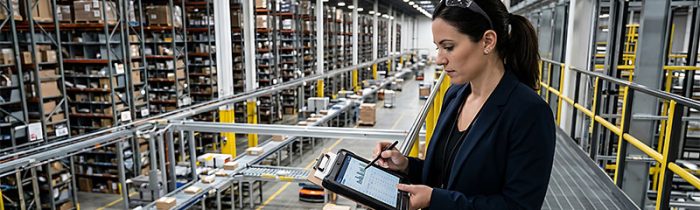
As warehouses expand, visibility will be the foundation for warehouse intelligence
Guest blog by Todd Boone, VP of North America, Dexory (MHI member)
After several years of slowing development, U.S. industrial real estate construction is beginning to pick up again. Research from Cushman & Wakefield shows approximately 305 million square feet of industrial space was under construction during the second quarter of 2026, an 18% increase year over year. While warehouse capacity continues to expand, each new facility introduces greater operational complexity.
Warehouse growth brings new operational challenges
As facilities become larger and logistics networks more distributed, the challenge shifts from finding room to store inventory to understanding exactly what is happening inside increasingly complex operations. Companies must balance unpredictable demand, persistent labor shortages, growing SKU counts and rising customer expectations, all while relying on inventory data that is often incomplete or out of date.
Labor availability has also remained a persistent challenge for the sector. Descartes research found that 76% of supply chain and logistics leaders are experiencing notable workforce shortages in their operations. At the same time, organizations expanding their warehouse footprints cannot necessarily expand their workforce at the same rate, making it increasingly difficult to maintain visibility across inventory assets and drive efficient workflows.
The upturn in warehouse construction may relieve capacity pressures in the short term, but without better operational intelligence, every new facility also introduces more complexity. More locations create more inventory to track, more assets to manage and more opportunities for inefficiencies to go unnoticed. Expanding physical infrastructure without expanding visibility simply scales existing operational challenges.
Why real-time data changes the equation
For many organizations, the next phase of warehouse investment will focus less on how much space they can build and more on how effectively they can use the space they already have.
Organizations need a continuous understanding of what is happening across their facilities so they can make faster, more informed decisions. Without accurate, real-time data, even the most advanced warehouse technologies operate with an incomplete picture of inventory, assets and workflows, limiting their ability to generate meaningful operational intelligence.
Warehouse performance has always been measured through familiar metrics, such as throughput, storage density, inventory accuracy and labor productivity. What is changing is the ability to improve performance across these areas by pairing continuous visibility with warehouse intelligence, turning live operational data into faster, more informed decisions.
Storage density is a good example. When operators lack confidence in inventory location and availability data, they may be unable to use available capacity as efficiently as possible. Real-time visibility changes that equation by providing a continuously updated understanding of inventory and available space, helping facilities to increase storage density without sacrificing accessibility.
Inventory accuracy follows a similar pattern. Traditional cycle counting offers only periodic snapshots of warehouse conditions. Between counts, misplaced pallets, incorrect stock movements or inventory discrepancies may go unnoticed for days or weeks. By the time errors surface, they have often disrupted workflows with a ripple effect that extends beyond the original error.
Every new warehouse should be smarter than the last
Continuous inventory monitoring fundamentally changes this model. Rather than relying on scheduled audits and stale data, operators gain a real-time view of inventory location, movement and availability. Instead of discovering problems after they occur, they can identify and resolve them as they emerge.
Every new facility also creates an opportunity to apply what operators have learned from the last. Continuous visibility gives organizations a clearer understanding of how space is actually used, where bottlenecks develop and how inventory moves through the operation. Those insights can inform not only day-to-day decisions, but also the design and configuration of future facilities.
Visibility provides the data, but warehouse intelligence enables better decisions. By continuously interpreting live operational conditions, organizations can identify inefficiencies before they affect productivity.
Warehouses already generate vast amounts of operational data, but data alone does not improve performance. The value comes from turning that information into a live operational picture, enabling decisions based on what is actually happening in the warehouse rather than assumptions or outdated reports.
Technologies such as autonomous inventory monitoring and digital twins are making this possible by continuously capturing warehouse conditions and creating dynamic digital representations of physical operations. Rather than relying on stale static reports or manual inspections, operators can understand inventory movement, storage utilization and operational bottlenecks as they develop.
Building for continuous intelligence
Historically, warehouse planning has focused on physical infrastructure: clear heights, racking layouts, dock doors and material handling equipment. Those decisions remain essential, but they are no longer sufficient on their own.
Designing warehouses with continuous visibility built in from the outset creates a foundation for ongoing optimization throughout the life of the facility. The industry is already moving in this direction. Gartner research predicts that by 2030, half of all new warehouses built in developed markets will be designed as robot-centric facilities, reflecting a broader shift toward software-defined, AI-enabled operations.
As warehouses become autonomous, continuous visibility will become even more important. Real-time insight into inventory, assets and operations gives businesses the data they need to understand performance, identify opportunities for improvement and continuously optimize increasingly automated environments.
Turning visibility into competitive edge
As warehouse networks continue to expand and become more complex, operational awareness becomes increasingly difficult to maintain. Organizations that pair physical growth with continuous visibility and warehouse intelligence will be better equipped to make faster decisions, optimize performance and respond effectively to disruption. The warehouses that deliver the greatest value won’t simply be those with the most capacity or automation, but those that can continuously understand, adapt and improve how that capacity is used.

