


The Retention Illusion: Why Your Hardware is the Only Turnover Strategy That Matters
Guest blog by MHI member Flexcon Containers
The transportation and warehousing sector replaces nearly half its workforce every year. Even though replacing an employee costs roughly 16 to 20 percent of their annual salary, the industry often treats this attrition as an unavoidable reality of the business. Recruiting has become a permanent, operational tax, with employers relying on modest sign-on bonuses or superficial perks to stem the tide rather than addressing the root cause.
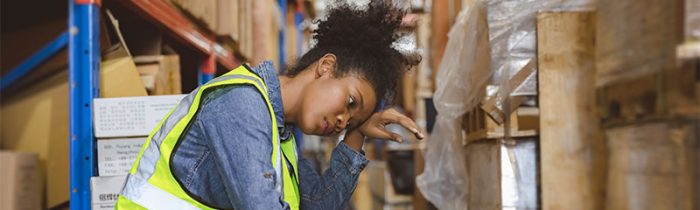
If you ask employees why they leave, the answer tends to point directly at the physical environment. Industry surveys reveal that 69 percent of associates cite physical exhaustion, with 73 percent consider quitting over physical discomfort. Asking an operator to spend a ten-hour shift fighting flimsy cardboard in a chaotic storage system tells them exactly how little you value their time. Righting the ship requires treating the floor itself as your retention program.
The framework to do this is the 5S methodology: Sort, Set in order, Shine, Standardize, and Sustain, anchored by professional hardware.
Eliminating the Friction of the Search
Friction starts the moment a picker walks down an aisle… If a quarantine area looks exactly like active inventory, your sorting discipline has already failed. Using vibrant color, like red hopper-front bins strictly for tagged items, creates a permanent, undeniable physical boundary. With handling and searching consuming up to half of a picker’s time, that organization has to extend inside the container itself.
A container holding loose, mixed parts, forces your operator to perform a manual sort at the worst possible moment. By replacing an open bucket with a precise grid of exact-fit dividers, every single pick is pre-sorted at put-away. Add a clear tote or hopper-front design, so the operator can visually confirm the part without lifting the bin, and you immediately stop burning their mental and physical energy on the first step of the process.
You Can’t Clean a Paper Warehouse
That physical exhaustion workers complain about is not only the heavy lifting, but also the environment they are breathing. Cardboard inherently sheds fiber against conveyor rails and rack beams, generating airborne particulates that enter the work environment and slowly impact working comfort. Furthermore, published testing proves cardboard loses up to 41 percent of its compression strength in humid conditions, turning the material into a collapsing harbor for mold and debris.
Transitioning to ultrasonically welded corrugated plastic or smooth molded totes instantly eliminates this waste stream. Robust polymer containers feature smooth internal walls and drainage holes, allowing for rapid, total sanitation. Working in a facility that actually feels clean signals to your team that their respiratory health matters, and shifts the psychology of the job from working in rough conditions to operating in a professional environment.
The Common Language of the Floor
When the physical environment is clean, the workflow needs to be predictable, and a patchwork of different container profiles creates daily chaos. Standardizing the warehouse floor means utilizing one master container footprint across decanting, storage, Goods-to-Person stations, and packing.
This predictability also extends to the digital front, where all systems require a frictionless digital handshake to operate efficiently. When a multi-client facility processes hundreds of automated picks per hour, an unstable platform starts lying to your people the moment a label becomes unredable. When barcodes get tucked into the exact same recessed, protected geographic spot on every single bin, robotic scanners never miss a beat. Just as importantly, the human picker’s eye never has to hunt, and they never have to needlessly rotate a heavy box just to find out what is inside.
The True Cost of Respect
It’s impossible for a worker to take pride in a taped-up cardboard box that is collapsing under its own weight, but it’s far easier to take ownership over a professional tool. By moving from impulsive, cost-cutting purchasing habits, to sustainable, robust handling systems, you’re building a warehouse where the air is clean, the workflow is intuitive, and the tools are professional.
Reusable containers arrive on the floor as fixed infrastructure, engineered for hundreds or thousands of trips. Investing in durable containers sends a distinct message to the floor: the company is here to stay, and so are you.
The comparison worth making is the crushing, recurring 20 percent salary hit of replacing half your headcount every year, set against a one-time investment in professional infrastructure. Equipping your facility with the right tools is the only retention strategy that actually moves the needle.

