


How Shuttle Systems Are Changing the Economics of Small-Parts Automation
Guest blog by MHI member Stoecklin Logistics Inc.
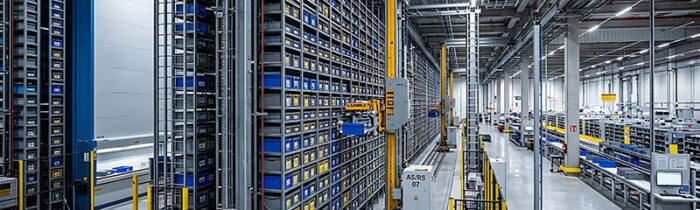
As warehouses face rising order volumes, tighter delivery windows, and more pressure to make better use of available space, small-parts automation is becoming an important part of the material handling strategy. Shuttle systems offer one way to address these challenges. By combining high-density storage with automated storage and retrieval, shuttle technology can help warehouses increase throughput while reducing manual movement and making more effective use of vertical space.
Unlike traditional automated storage and retrieval systems that may rely on a single piece of equipment to serve an entire aisle, shuttle-based systems can deploy multiple independent vehicles working in parallel. That architecture can provide both high performance and a degree of redundancy that is valuable in operations where availability is critical.
Flexibility Starts With the Storage Media
One of the most important considerations when evaluating a shuttle system is what it can actually handle. Modern miniload shuttle systems can accommodate a range of containers, cartons, and trays, allowing facilities to select storage media based on their products rather than forcing products into a predetermined format. Some systems can handle loads weighing up to 110 pounds and support single, double, or multi-deep storage configurations.
This flexibility also matters as an operation changes. Product dimensions, inventory profiles, and order volumes can evolve over time. A modular shuttle system can allow storage density and system performance to be adjusted as requirements change.
For facilities operating in challenging environments, temperature capability is another consideration. Shuttle technology can be designed for applications ranging from ambient storage to temperature-controlled environments, including refrigerated and frozen operations.
Parallel Automation Can Increase Availability
A key characteristic of shuttle technology is the ability to operate multiple vehicles independently across storage levels. Rather than depending on a single vehicle to perform every storage and retrieval task, multiple shuttles can work simultaneously. Warehouse control software coordinates their movements and assigns transport tasks according to factors such as location, priority, and route.
This distributed approach can also provide operational redundancy. If a shuttle requires maintenance or replacement, other vehicles can continue operating. In high-throughput environments, the ability to service individual vehicles without bringing an entire system to a halt can be particularly valuable. Accessibility is therefore an important part of system design. Maintenance teams need practical access to equipment, while operators need confidence that routine service requirements will not create extended interruptions.
Software Is Just as Important as the Hardware
A shuttle system is more than a collection of vehicles and racks. Warehouse management and control software determines how inventory moves through the system, creates transport orders, and coordinates equipment. Effective software integration can help optimize routes and sequencing while providing visibility into inventory and system activity.
This connection between software and automation also creates opportunities for proactive maintenance. System data can help identify potential issues before they result in unplanned downtime, allowing maintenance activities to be incorporated into normal operations where possible. For companies evaluating automation, the software architecture should therefore receive the same attention as equipment specifications. The ability to integrate with an existing WMS, warehouse controls, and material flow infrastructure can have a significant effect on the overall value of an installation.
Designing for What Comes Next
The strongest case for shuttle technology may ultimately be its ability to adapt. Warehouse operators rarely know exactly what their operation will look like five or 10 years from now. Order profiles change, product assortments expand, labor availability fluctuates, and customer expectations for delivery speed continue to evolve.
A modular approach allows automation to be designed around current requirements while providing a path for future expansion. Storage depth, vehicle quantity, rack configuration, conveyor connections, and software capabilities can all be considered as components of a larger system architecture. That makes scalability an important consideration alongside headline throughput numbers.
The goal is not simply to install the fastest possible system, but is to create an automated material flow solution that matches the facility’s inventory characteristics, throughput requirements, available space, and future growth plans.
Building a Better Automation Strategy
Shuttle systems are not a universal answer for every warehouse. Their value depends on factors including SKU characteristics, container types, order profiles, required throughput, temperature requirements, available space, and integration with existing material handling equipment. For operations where those factors align, however, shuttle technology can provide a combination of high-density storage, automated handling, parallel operation, and scalability.
As warehouses continue to move toward more connected and automated operations, the focus is shifting from individual pieces of equipment to complete material flow systems. Shuttle technology is one example of that evolution, bringing storage, transportation, software, and controls together to create a more responsive approach to small-parts fulfillment.

