



Designing Safer Warehouse Operations with Automated Storage & Retrieval Systems (ASRS)
Guest blog by Jason Stahl, Solutions Development Manager at Murata Machinery USA (Muratec USA), a member of MHI and ASRS Industry Group
Warehouse safety has always been a priority for supply chain and logistics leaders, but today’s operations face rising complexity. Higher throughput demands, tighter labor markets, and increased pressure to reduce injuries are forcing organizations to rethink how work is designed on the warehouse floor. One technology increasingly central to the safety conversation is Automated Storage and Retrieval Systems (ASRS).
ASRS is often discussed in terms of space utilization, speed, or inventory accuracy. However, one of the most significant—and sometimes underappreciated—benefits is the impact on workplace safety. When implemented thoughtfully, ASRS fundamentally changes how people interact with materials, equipment, and their environment, creating safer and more predictable operations.
Removing People from High-Risk Tasks
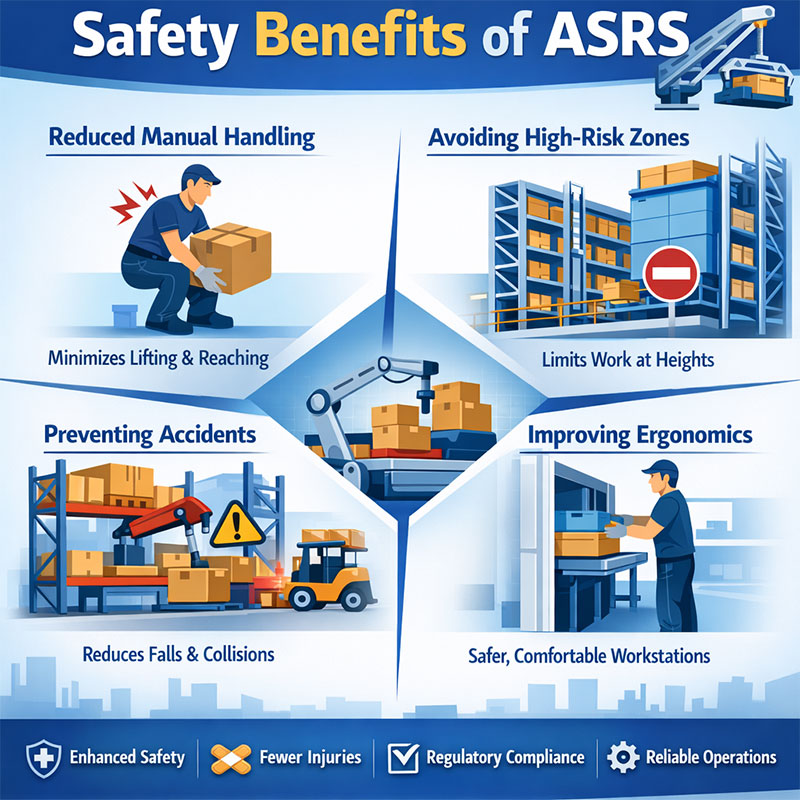
At its core, ASRS improves safety by reducing the amount of manual, high-risk work people perform. Traditional warehouse environments often require employees to lift heavy items, travel long distances, work at heights, or operate forklifts in narrow aisles. Each of these activities introduces potential safety hazards.
ASRS shifts these risks away from people and onto engineered systems. Automated cranes, shuttles, or robotic devices handle vertical movement, most of the heavy lifting, and repetitive tasks with precision and consistency. As a result, employees are away from the risks of falls, collisions, and dropped loads—some of the most common sources of warehouse injuries.
Rather than climbing racks or maneuvering equipment in congested spaces, workers interact with goods at controlled access points, often at ergonomic workstations designed to minimize risk and fatigue.
Improving Ergonomics and Reducing Physical Strain
Safety is not limited to preventing acute accidents; it also includes reducing workforce turnover. Repetitive motion, awkward postures, and excessive walking contribute to musculoskeletal injuries that can sideline employees and impact productivity over time.
ASRS significantly improves warehouse ergonomics by changing how picking and replenishment work is performed. In many ASRS-based workflows:
• Workers remain largely stationary instead of walking miles per shift
• Items are delivered at consistent, optimized heights
• Bending, twisting, and overhead reaching are minimized
• Heavy lifting from floor level or above shoulder height is reduced or eliminated
These changes transform physically demanding jobs into more sustainable, repeatable work. In addition to lowering injury risk, improved ergonomics can enhance pick accuracy, reduce fatigue, and support employee retention—an important consideration in today’s tight labor market.
Creating a More Controlled and Predictable Environment
Manual operations often rely on human decision-making in fast-moving, dynamic environments, where distractions or inconsistencies can lead to mistakes or injuries. ASRS introduces a level of predictability and control that manual processes struggle to match.
Automated systems move loads consistently, follow programmed paths, and operate within clearly defined zones. This precision lowers the likelihood of unexpected movements that can cause incidents. When properly designed, ASRS creates a safe barrier between people and moving equipment, which is one of the most critical safety improvements ASRS can deliver.
From a regulatory standpoint, reducing manual material handling aligns well with occupational health and safety standards.
Designing Safety into the System from Day One
Separation of ASRS and employees is an important principle that begins during system design, not after installation. Effective implementations ask fundamental questions early in the process, such as:
Can a person access moving equipment?
If so, how is that interaction mitigated or eliminated?
Answers to these questions shape the system’s engineering. Common safety features integrated into ASRS designs include physical guarding, safety fencing, light curtains, interlocked doors, and controlled access zones. These measures are not add-ons; they are integral to how automated systems are engineered to protect both people and equipment.
While the safety benefits of ASRS may not always appear as a single line item on an ROI spreadsheet, their impact is measurable over time. Fewer injuries mean reduced downtime, lower workers’ compensation costs, and less disruption to operations. Protecting people also protects capital assets, helping systems operate reliably for years to come.
Safety, Reliability, and Long-Term Performance
There is a strong correlation between safety and system reliability. Automated systems designed to operate within well-defined, controlled parameters are not only safer but also often more dependable. Reduced human intervention lowers variability, supports uptime, and enables consistent performance.
In that sense, safety and operational excellence are closely linked. The safest systems tend to deliver the strongest long-term value.
Rethinking the Role of Automation
ASRS isn’t simply about moving loads faster or storing more inventory in less space. It represents a broader shift in how warehouses are designed around people. By allowing automation to handle heavy, repetitive, and hazardous tasks, organizations can create environments where employees do their best work—safely, comfortably, and consistently.
As the industry continues to evolve, ASRS will play an increasingly important role not only in efficiency but also in shaping safer, smarter warehouse operations for the future.

