


End to End Automation: What Happens When ASRS, Conveyors, and Robotics Operate as One System
Guest blog by MHI member LOG-X Systems GmbH
The Shift Toward Unified Warehouse Automation
Warehouses today are navigating a landscape defined by rising order volumes, tighter delivery windows, and ongoing labor shortages. For many years, automation was deployed as a series of isolated solutions, an ASRS installed to solve storage constraints, a conveyor line added to accelerate carton movement, or a handful of AMRs introduced to reduce manual travel. Each system delivered value, but none fundamentally changed the rhythm of the operation. That transformation only occurs when these technologies stop functioning independently and begin operating as one unified, end‑to‑end automation ecosystem. This shift toward integration is reshaping how modern fulfillment centers think about speed, accuracy, and resiliency.
ASRS as the Central Engine of Modern Fulfillment
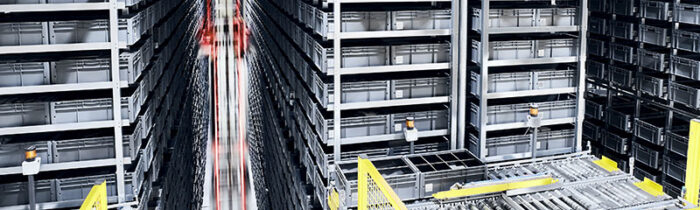
At the core of this ecosystem is the Automated Storage and Retrieval System. ASRS has long been recognized for its ability to maximize vertical space and deliver inventory with precision, but its role has expanded dramatically. Today’s ASRS behaves like a dynamic inventory engine, constantly retrieving goods based on real‑time demand signals and feeding them directly into downstream automation. Instead of waiting for manual intervention, the ASRS becomes an active participant in the fulfillment process. Totes, cartons, and pallets flow out of storage exactly when needed, creating a steady, predictable rhythm that sets the pace for the entire warehouse.
Conveyors: The Continuous Flow That Connects Every Zone
Once items leave the ASRS, conveyors and sortation systems take over. These systems form the continuous flow that connects every operational zone, moving products between storage, picking, packing, and shipping. In an integrated environment, conveyors do far more than transport goods. They respond to system conditions in real time, adjusting speed, diverting items, accumulating intelligently, and releasing products based on order priority or station availability. This creates a synchronized material flow where every movement is intentional, and every product is guided by software that understands the entire operation. Conveyors become the connective tissue that ensures no zone operates in isolation.
Mobile Robotics Bring Flexibility to Fixed Infrastructure
While conveyors handle predictable, high‑volume routes, AMRs and AGVs introduce flexibility and adaptability. These mobile robots navigate autonomously, bridging gaps between automation zones and supporting workflows that shift throughout the day. They retrieve totes from ASRS output points, deliver goods to robotic picking cells, move completed orders to packing, and support replenishment tasks. Their ability to adapt without major infrastructure changes makes them essential in facilities that require both speed and agility. Together, conveyors and mobile robots create a hybrid material flow architecture that is stable, scalable, and responsive.
Robotic Picking and Palletizing Close the Automation Loop
The final step toward true end‑to‑end automation comes from robotics. Robotic picking, palletizing, depalletizing, and case handling eliminate the last major manual bottlenecks. When robots receive items directly from conveyors or AMRs, they operate with consistent cadence, high accuracy, and minimal downtime. With advanced vision systems and machine learning, these robots continuously improve, becoming faster and more reliable over time. Their integration ensures that throughput remains strong even during labor shortages or peak demand periods.
The Business Impact of True End‑to‑End Automation
When ASRS, conveyors, AMRs, AGVs, and robotics operate as one system, the warehouse becomes a cohesive, intelligent ecosystem. Throughput increases, labor dependency decreases, and operational predictability improves. End‑to‑end automation doesn’t just modernize the warehouse, it future‑proofs it, giving companies the resiliency they need to thrive in a rapidly evolving supply chain landscape.

