


Rethinking Pedestrian Safety in High-Density Warehouse Environments
Guest Blog for MHI Member Speedrack Products Group
Integrating protection without sacrificing storage capacity
As warehouse operations push toward higher density and faster throughput, a persistent challenge has emerged: how to improve pedestrian safety without giving up valuable storage space.
In modern facility design, safety and space utilization are often in tension. As footprints tighten and operational demands increase, operators must find ways to maintain safe pedestrian movement without compromising storage density or disrupting workflow. One of our recent warehouse projects helps illustrate how this balance can be addressed through integrated design rather than traditional tradeoffs.
The Evolving Challenge
Many distribution facilities face a similar condition: a transition point between office and warehouse environments. These areas typically experience frequent pedestrian traffic moving into spaces with active forklifts, overhead loads, and dynamic material handling activity.
The conventional solution has been to designate pedestrian aisles, often requiring several feet of dedicated floor space along walls or travel paths. While effective from a safety standpoint, this approach can reduce available storage capacity, which is an increasingly costly compromise in high-density operations.
At the same time, simply marking walkways or relying on administrative controls is often insufficient in environments with heavy equipment and limited visibility. The challenge becomes how to create clearly defined, physically protected pedestrian pathways without eroding operational efficiency.
Constraints That Shape Design Decisions
Facilities addressing this challenge often face a common set of constraints:
· Limited footprint: Maximizing storage density leaves little room for dedicated walkways
· Frequent pedestrian movement: Regular transitions require a clearly defined, protected path
· Multiple access points: Doorways and access areas must remain unobstructed
· Active operations: Forklift traffic and overhead storage introduce ongoing hazards
· Facility consistency: Infrastructure must align with existing equipment and design standards
These constraints reflect broader trends across the material handling industry, where facilities are expected to do more within tighter physical and operational limits.
Moving Beyond Add-On Safety
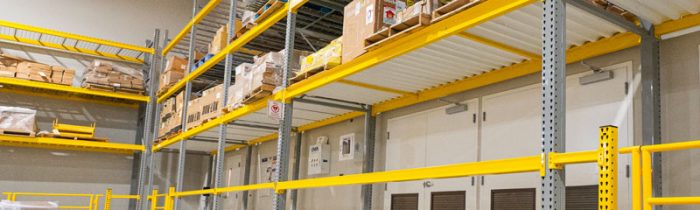
One notable shift in approach is treating pedestrian safety as an integrated design element rather than an add-on. Instead of carving out space for a separate pedestrian aisle, protection can be incorporated directly into the storage system itself, creating a defined, rack-integrated pedestrian corridor.
This approach embeds safety into the physical infrastructure, using structural elements to provide both overhead and side protection. By doing so, it avoids the typical trade-off between safety and storage capacity while maintaining operational flow.
From a systems perspective, this represents a move toward multi-functional infrastructure, where a single installation serves both operational and safety objectives.
Key Design Considerations
Several design principles emerging from this approach may be broadly applicable across warehouse environments:
1. Physical Separation Over Visual Cues
Clearly defined, guarded pathways provide a higher level of protection than painted lines or signage alone, particularly in high-traffic areas.
2. Protection from Multiple Hazard Types
Effective pedestrian safety solutions should address not only vehicle interaction but also overhead risks, such as falling objects from storage systems.
3. Maintaining Operational Access
Designs must accommodate existing workflows, including doorways, staging areas, and material flow paths, without introducing bottlenecks.
4. Integration with Existing Systems
Solutions are more likely to be adopted and maintained when they align with existing equipment, layouts, and facility standards.
5. Scalability and Repeatability
As organizations expand or replicate facilities, adaptable design concepts can provide long-term value beyond a single installation.
Broader Implications for the Industry
As warehouse operations continue to evolve, the pressure to maximize both cubic and square-foot utilization will only increase. At the same time, safety expectations from regulatory bodies and internal stakeholders alike are becoming more stringent.
This dynamic underscores the need for design strategies that eliminate false trade-offs. Rather than viewing safety and storage as competing priorities, integrated designs make it possible to achieve both.
For MHI members, this raises several important questions:
· How can safety be embedded earlier in the facility design process?
· Where are traditional solutions limiting operational efficiency?
· What opportunities exist to combine structural systems with safety functions?
Conclusion
Pedestrian safety in active warehouse environments does not have to come at the expense of storage density or operational performance. By integrating protection directly into the physical infrastructure, facilities can create safer, more efficient environments without expanding their footprint.
As facilities continue to evolve, the ability to design systems that serve multiple functions may become a defining characteristic of high-performing warehouse environments.

