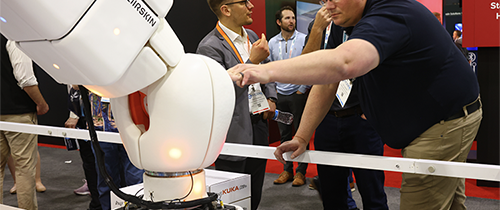
Seeing Equipment and Technology Demonstrations In-Person Is Essential for Today’s Supply Chain and Logistics Teams
In an era defined by automation, AI, robotics, and real-time decision-making, supply chain leaders face unprecedented pressure to modernize their operations. Every investment—whether in autonomous mobile robots, warehouse automation, AI planning platforms, or material handling equipment and systems—must demonstrate speed, precision, and measurable ROI.
But here’s the truth, few supply chain pros say out loud:
You can’t truly evaluate supply chain technology until you see it in person, in action.
The gap between a slick product brochure or website and a real‑world, functioning system can be massive. That’s why hands‑on equipment and technology demonstrations have become mission‑critical for operations, engineering, and procurement teams. There is no better place to see the best and most innovative supply chain equipment and technology than MODEX 2026, coming to Atlanta April 13-16. MODEX is the largest supply chain event of 2026, featuring the solutions of over 1,000 exhibitors and including a conference of 200 sessions.
Here are the Top 7 Ways MODEX Demos Can Help Your Team Innovate and Modernize Your Supply Chain Operations
1. Demonstrations Reveal What Technology Really Does—Not Just What It Claims to Do
Every vendor can talk about throughput, uptime, or automation gains. But live demos expose the details that matter:
—How fast does the robot actually navigate a busy aisle?
—Does the picking system work consistently, or only under ideal conditions?
—Does the software interface make sense to the teams who will use it daily?
—Does the equipment require complex integration—or plug in and perform?
Seeing systems run in real time separates marketing from reality. It prevents costly missteps and ensures your team selects solutions that deliver on their promises.
2. Physical Demonstrations Help Teams Compare Solutions Side‑by‑Side
In supply chain operations, the alternatives often look similar on paper. But when equipment is running two aisles apart, the differences become obvious:
—Cycle times
—Noise levels
—Footprint and required space
—Speed, accuracy, and safety behaviors
—Interactions with people, pallets, and other machines
This side‑by‑side comparison is impossible to replicate in a sales deck or a virtual meeting. It accelerates decision‑making and sharpens investment strategy.
3. Demonstrations Build Confidence for High‑Stakes Capital Investments
Automation, robotics, and warehouse systems are major, long‑term commitments. Teams considering multi‑million‑dollar investments need visible proof that:
—The system is stable
—The technology scales
—The workflow actually improves productivity
—The vendor can support and maintain the solution
A live demonstration answers the question that every executive quietly asks:
“Will this work in my environment?”
4. Seeing Systems in Action Reduces Risk and De‑Risks Implementation
No simulation, video, or slide deck can reveal how technology behaves under real‑world stress. Demonstrations expose edge cases:
—How systems respond when something goes wrong
—How equipment handles variability in packaging, labels, shapes, or sizes
—Whether AI or vision systems cope with imperfect or messy environments
—How the technology recovers from disruptions
In industries where downtime is expensive, and SLAs are unforgiving, de‑risking is not optional—it’s essential.
5. Live Demos Inspire Your Team with New Ideas, New Layouts, and New Operating Models
Supply chain innovation often begins with a simple moment:
“What if we applied this technology to our bottleneck?”
When leaders see equipment running—robots, conveyors, sorters, palletizers, vision systems, digital twins—they start envisioning new possibilities:
—Redesigned warehouse workflows
—Completely new picking or packing strategies
—Cross‑functional automation
—Digital‑physical integration that wasn’t obvious before
Seeing technology in motion sparks creativity in ways static presentations simply cannot.
6. Demonstrations Accelerate Team Alignment and Buy‑In
Transformation only works when people believe in it. Bringing operators, managers, engineers, and executives to a live demonstration:
—Builds shared understanding
—Aligns expectations
—Helps teams ask smarter questions
—Generates excitement
—Reduces resistance to change
Hands‑on experiences turn skepticism into advocacy faster than any internal memo could.
7. Technology Demonstrations Humanize the Buying Process
Modern supply chain solutions are increasingly complex. Building relationships with the engineers, designers, and developers behind the technology helps organizations:
—Understand product roadmaps
—Preview upcoming releases
—Influence feature development
—Build trust and long‑term accountability
In a world moving toward agentic AI and physical automation, partnership matters as much as the technology itself.
The Bottom Line—Your Team Cannot Afford to Miss MODEX 2026
Modern supply chains are being rebuilt around automation, autonomy, intelligence, and resilience. But choosing the right equipment—robots, sensors, software, platforms, machinery—cannot be done from a brochure. MODEX is your team’s best opportunity in 2026 to see this equipment and tech in-person, in-action and help to:
—Deliver clarity.
—Reduce risk.
—Accelerate adoption.
—Inspire innovation.
—Make investments that actually move the needle.
In today’s supply chain landscape, the leaders who show up at MODEX 2026 will be the ones who build the supply chains everyone else tries to catch
Don’t miss out on your chance to innovate your operations, register your team today for
MODEX – April 13-16 in Atlanta’s Georgia World Congress Center. Visit
modexshow.com to learn more and to register at no cost.