


The Five Software Pillars of Robotic Order Fulfillment Execution
Guest blog by Dan Gilmore, Chief Marketing Officer, Roboteon and Raj Sengetuvan, Senior Vice President of Product, Roboteon (MHI member company)
A sizable percentage of autonomous mobile robot (AMRs) implementations have successfully produced success and a high return on investment (ROI). However, too many are not meeting expectations in terms of cost savings, robot utilization, and time-to-value. Others have moderately successful deployments but could improve results.
So, what’s going on?
In warehouse robotics initiatives, the focus is mostly on the hardware aspects. That’s understandable, as that’s what can be seen and hardware specs (such as speeds, payloads, and accessories) are easy for vendors to communicate and for users to compare.
But what really matters for the success is the execution software that coordinates the robots with workers. Frequently, the root cause of deployment and performance issues lies with the software.
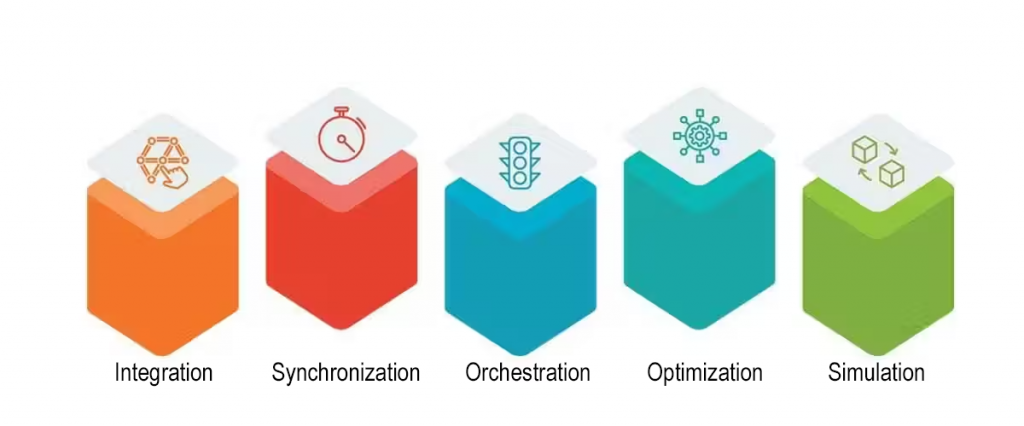
To get the software equation right and maximize your results and time-to-value, you need to make sure you have established the five key pillars of robotics fulfillment execution:
Pillar 1: Integration
Key problems to solve: Long, expensive, risky, and/or inflexible integrations and “vendor lock-in”
Integration challenges are often the source of problems and delays in robotics initiatives—and sometimes lead to outright project failure. For example, we recently encountered an auto industry manufacturer that has two dozen AMRs parked on the factory floor because the company could not get that fleet to integrate with another AMR fleet as part of the planned workflow.
The reality is that too many companies and system integrators rely on manual/hard-coded integration, which takes much time and effort and is often high risk. And if the robot original equipment manufacturer (OEM) does the integration, you can also experience what is termed “vendor lock-in,” in which it’s difficult, if not impossible, to deploy robots from different vendors over time, limiting flexibility.
Although vendor APIs provide a powerful integration tool, interoperability between heterogenous systems is still a challenge, as different vendors have different APIs. Standards are coming but aren’t widely adopted.
Companies should look to overcome these challenges by utilizing a flexible automation middleware layer that offers pre-built integrations or utilizes modern tools such as artificial intelligence (AI)-based API data mappers.
Pillar 2: Synchronization
Key problem to solve: Excessive dwell times for robots and humans
In adopting warehouse robotics, companies will have to manage the work of not only the robots but also human resources. This is a lot harder than it might seem.
Synchronization involves aligning human and robotic workflows to minimize “dwell time”—the time a human waits for a robot or the time a robot wastes waiting for a human. There are several factors for the software to consider as it synchronizes fulfillment, including the payload (weight) the robot can carry, its real-time position in the warehouse, aisle congestion, and other operating conditions.
Pillar 3: Orchestration
Key problems to solve: Lack of coordination among heterogenous systems and failure to maximize throughput and robot utilization
Many companies today deploy not just an initial fleet of AMRs but also robotics of different types and from different vendors. In the future, a “heterogenous fleet” of robots will certainly be common. In addition, warehouses will continue to have nonrobotic types of warehouse automation and manual processes.
We believe that orchestration of all of the warehouse’s automated and nonautomated resources is the backbone of effective robotic order fulfillment. The goal should not be to achieve local optimization of each individual node but rather to maximize total facility throughput. This can only be achieved by integrating processes so that they maintain a near continuous flow of goods.
Without what is often termed an “orchestration engine,” the automated and nonautomated resources discussed above operate in silos. As an example, a picking robot might work at maximum speed only to overwhelm the packing stations downstream.
Achieving this is not easy. But without such orchestration capabilities, companies are unlikely to achieve their full robotics fulfillment potential. Look to vendors that have such capabilities.
Source: Supply Chain Xchange
Pillar 4: Optimization
Key problems to solve: Not getting the full benefits of your robotic fulfillment capabilities.
The fulfillment orchestration capabilities described above—which are available in some robotics management software—can deliver significant improvements in productivity, throughput, and robot utilization. But companies can create even greater operational benefits by layering AI and more traditional optimization technology onto that software.
In a modern warehouse, AI/ML algorithms can be used to optimize various facets of fulfillment, including order clustering, path planning, slotting optimization, and more.
Pillar 5: Simulation
Key problem to solve: Suboptimal decision-making throughout a robotic implementation project
For decades, companies have been using simulation to validate major material handling projects, but because of the time and cost involved, it generally has only been viable for the largest initiatives. Advances in simulation software, however, are making the process less costly and much faster.
As a result, simulation is becoming a vital tool for improving decision-making across the entire lifecycle of a robotics project, from initial design to daily operations. For example, during the initial strategic and design phase, digital twins that provide virtual replicas of the physical warehouse can be used to understand the impact of different design choices on a wide variety of operational metrics Particularly valuable is the ability to conduct “what-if” analysis to test various layout configurations, resource mixes, and other operational assumptions. These simulations can be used to develop and present the business case for robotics, adding clarity and precision to the numbers.
Beyond the design phase, simulation allows managers to test and refine tactical plans, such as determining how many robots and humans to employ during peak season.
Simulation and digital twins can also be used to test near-term decisions before executing them, empowering data-driven, real-time decision-making.
Impact of the 5 Pillars
To move beyond siloed automation and achieve the full potential ROI, organizations must look past hardware specs and master the Five Software Pillars of Success: seamless integration, precise synchronization, holistic orchestration, AI-driven optimization, and predictive simulation.
Companies that can deliver the above capabilities will almost certainly unleash the full potential of robots in the warehouse for the near and long term.’

