


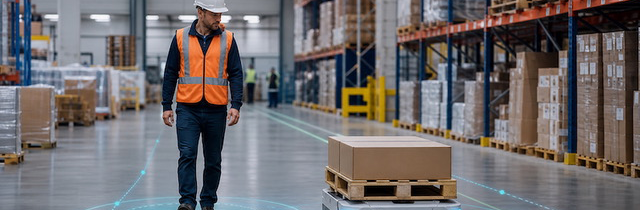
Why AMR Safety Starts with the Human on the Floor
Autonomous mobile robots are transforming warehouse operations, but the most overlooked safety challenge is the human being sharing the floor with them.
Guest blog by MHI member Pozyx
The autonomous mobile robot (AMR) arrived in the warehouse with a promise: smarter movement, fewer errors, less physical strain on workers. That promise is largely being delivered. Cycle times are down, pick accuracy is up, and labor is being redeployed from repetitive transport tasks to higher-value work.
The safety picture is more complicated. A peer-reviewed analysis of Bureau of Labor Statistics data by NIOSH researcher Larry Layne, published in the American Journal of Industrial Medicine in 2023, identified 41 robot-related fatalities in the United States between 1992 and 2017. That number is small compared with total workplace fatalities in the same period, but it points to a category of risk that traditional warehouse safety programs were not built to address. The people working around robots, not the robots themselves, are where the exposure lives.
The floor is getting more crowded, not less
The instinct, when bringing in AMRs, is to focus on the robot. How well does it navigate? How does it handle exceptions? Can it integrate with the warehouse management system? These are legitimate questions, but they center the machine.
The floor doesn’t work that way. On a live warehouse floor, the robot is one actor among many. Workers on foot cross traffic lanes. Forklifts and powered industrial trucks operate in adjacent zones. Temporary congestion forms at pick stations, dock doors, and charging areas. The human and the machine are constantly negotiating the same physical space, often without a clear shared language for doing so.
This is not a new problem. OSHA data show that 36 percent of forklift-related fatalities involve pedestrians, workers on foot sharing floor space with powered industrial trucks. The same underlying dynamic, human and vehicle moving through overlapping paths without sufficient coordination, applies when the vehicle is autonomous. Automation changes the nature of the vehicle. It does not automatically resolve the interaction problem.
Warehousing remains a high-injury environment
Context matters here. A September 2023 audit by the U.S. Department of Labor Office of Inspector General found that in 2021, the injury and illness rate in the warehousing industry was 5.5 per 100 employees, more than double the national rate across all industries. These are not abstract statistics. They reflect musculoskeletal injuries, struck-by incidents, and the compounding physical demands of fast-moving, high-density environments.
AMRs reduce certain injury vectors, particularly those tied to manual transport and heavy lifting. But they introduce new ones, or at minimum preserve old ones in new forms. A robot traveling at modest speed through a cross-aisle zone still represents a physical hazard to a worker who does not see it coming. Repeated near-miss events, even when they result in no injury, erode worker confidence and increase cognitive load across an entire shift.
Situational awareness is a system problem
There is a tendency to frame human-robot safety as a behavioral issue, just “train the workers better,” “post more signs,” “reinforce the pedestrian walkways.” These measures have value, but they treat the symptom rather than the cause.
The underlying cause is a lack of shared situational awareness. The robot knows where it is. The worker often does not know where the robot is, or where it is heading. The supervisor has no real-time view of how the two are interacting across the floor. Decisions about zone assignments, traffic routing, and shift staffing are made from lagging data, or from no data at all.
Real-time location systems, commonly called RTLS, address this gap directly. By tracking the position of both assets and people continuously, these systems create a common operational picture of the floor. Technologies such as ultra-wideband (UWB) positioning can provide the centimeter-level accuracy needed to detect genuine proximity events, not just general zone occupancy. That precision matters when the relevant distance is measured in meters, not aisles.
The value of this visibility is not limited to safety alerts. Aggregate data on human-robot proximity patterns can reveal chronic blind spots in a facility layout. They can validate whether traffic routing changes are actually working. They can provide the documentation that safety audits and insurance assessments increasingly require.
Where the investment conversation needs to go
When an operation calculates the return on its AMR deployment, the math typically covers throughput, labor reallocation, and error reduction. Worker safety and human-robot coexistence are often treated as soft considerations, things to address in training rather than in infrastructure.
That framing is becoming harder to sustain. Regulatory scrutiny of warehouse working conditions is increasing, as the recent OSHA and DOL findings make clear. Worker expectations around physical safety are shifting. And the operational cost of a serious injury, in lost time, retraining, regulatory response, and workforce confidence, is rarely captured in the AMR business case.
The blind spot is not the robot; it’s the assumption that deploying the robot completes the safety work. Understanding where your workers are, where your machines are, and how those paths intersect in real time is not a feature. For a facility serious about both performance and people, it is the foundation.

