



Why Vision AI Should Go Beyond Inspection Accuracy
Guest blog from MHI member SK AX USA
Visual inspection has long been one of the most important forms of quality control in manufacturing. Plants have traditionally relied on experienced inspectors or rule-based machine vision systems to identify defects and keep products within specification. While these methods remain essential, high-mix production, skilled labor shortages and subtle defect variations are stretching them to their limits. When environmental conditions, materials, or product variants change, static inspection rules quickly lose accuracy.
Vision AI offers a different approach. By learning patterns in image and processing data, it can support more complex decisions and adapt to changing conditions. While a camera or AI model alone does not create operational value, the real opportunity emerges when image acquisition, model learning, edge inference, feedback, and plant control are designed as one integrated operating loop.
Traditional Inspection Is Becoming Harder to Scale
Experienced inspectors bring valuable judgment and context, especially when defects are subtle or difficult to define. Yet fatigue, variation among operators and across shifts, and shortages of skilled workers can make consistent, around-the-clock inspection difficult.
Rule-based machine vision improves repeatability by applying predefined thresholds for size, shape, position, color, or contrast. It is often economical and effective for simple, stable processes. Its limitations become apparent when products, materials, lighting, or defect patterns change. Engineers may need to rewrite rules and repeatedly reset thresholds.
The hidden issue is not always inspection accuracy itself. It is the rising cost of maintaining it, including additional engineering time, production interruptions, scrap, rework, and inspection bottlenecks.
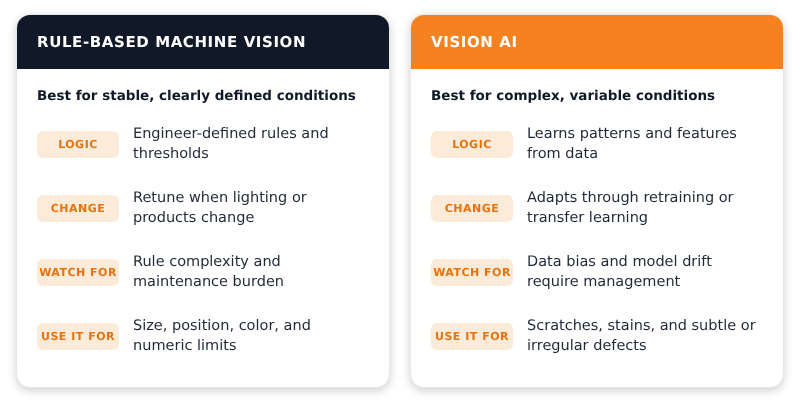
Figure 1. Select the approach based on process stability, variability, and business value.
Vision AI is better suited to defects that are complex, variable, or difficult to describe with fixed rules. This does not mean it should replace every conventional system. Stable processes may still be best served by rule-based machine vision; the right choice depends on the problem’s variability, business value, and operational risk.
Vision AI Is an Operating Loop, Not Just a Model
A production-ready Vision AI capability depends on five connected stages:
• capturing consistent images,
• learning from defect and process data,
• making real-time decisions at the edge,
• feeding inspection errors back into model improvement, and
• connecting results to plant controls.
Treating these stages as a single operating loop changes the design question. Instead of asking only which model is most accurate, manufacturers must ask whether the entire system can operate reliably at production speed as conditions change.
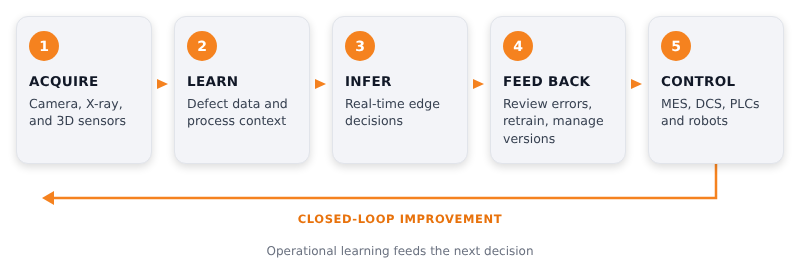
If any layer is weak, accuracy demonstrated in a lab may not hold up on the production line. Camera placement, lens selection, lighting, image-capture timing, line speed, defect frequency, network latency, and sensor stability all affect performance. Data quality and process context determine what the model learns, while edge infrastructure determines whether decisions can be made within the required cycle time.
Feedback is equally important. False accepts and false rejects should be captured, reviewed, and used for retraining and version control. Without this loop, performance may decline as materials, products, or operating conditions change.
The greatest value emerges when model outputs connect to manufacturing execution systems (MES), distributed control systems (DCS), programmable logic controllers (PLCs), robots, or other equipment controls. A detected defect can trigger an alert or an automatic reject action, while a recurring pattern may indicate that a process setting should be adjusted.
Measure Value Through Operational KPIs, Not Accuracy Alone
Inspection accuracy is necessary, but it is not a business outcome. A sophisticated model may create limited value if it targets a low-impact defect. A simpler model may generate greater value if it addresses a major source of quality loss, a production bottleneck, or a safety risk.
The business case should therefore connect model performance to the operational measures that matter to the plant and its P&L.
• Quality: Earlier defect detection and root-cause analysis can reduce scrap, rework, warranty claims, and quality escapes.
• Productivity: Faster inspection decisions and fewer inspection bottlenecks can improve cycle time, equipment utilization, and production throughout.
• Safety and ESG: Continuous visual monitoring can identify smoke, leaks, unsafe conditions, or other warning signs and shorten response time.
• Flexibility and autonomy: Vision results can support mixed-model production, robotic control, and the automatic adjustment of process conditions.
Applications vary by industry. Semiconductor manufacturers can use image and process data to support virtual metrology and reduce measurement bottlenecks, while battery producers can use X-ray imaging to identify internal defects. Petrochemical facilities can use continuous visual monitoring to detect hazardous conditions, and 3D vision can help assembly lines identify parts and their positions for flexible handling and robotic control.
Across these applications, value becomes clear only when AI results are linked to the cost of poor quality, bottleneck time, response time, risk exposure, production flexibility, and scalability across lines or plants.
From a Successful PoC to Closed-Loop Manufacturing
Many Vision AI initiatives demonstrate strong technical performance in a proof of concept (PoC) but struggle in production. A controlled pilot may not reflect changing lighting, rare defects, line-speed requirements, network interruptions, or new product variants.
The operating structure required to scale should therefore be defined before the PoC begins. Start with a process where defect costs, bottlenecks, or safety risks are material, and agree in advance on how success will be measured.
Each use case should establish:
• A target KPI and current baseline
• An expected level of improvement
• Clear failure and acceptance criteria
• An accountable operational owner
• A process for data collection, feedback, and model maintenance
Sustained results require coordination among plant operations, quality, engineering, IT, data and AI teams, and business leadership. World leading manufacturing integrators such as SK AX approach Vision AI as a connected operational capability that combines plant expertise, data architecture and sensor design, edge infrastructure, cybersecurity, MLOps, and integration with factory systems.
Vision AI is becoming a critical intelligence layer for the physical world of manufacturing. Its value depends not on how many cameras or models a plant deploys, but on whether manufacturers can turn visual data into reliable decisions, timely operational actions, and measurable business value.

