

From General AI to Vertical AI: Why Manufacturing Needs Industry-Specific Intelligence
Guest blog from MHI member SK AX USA
Over the past few years, artificial intelligence has rapidly moved from experimentation to practical business use. Many companies began testing general-purpose AI tools for productivity, research, reporting, and knowledge search. However, as AI adoption matures, manufacturers are realizing that the next wave of value will not come only from smarter general models. It will come from AI that understands the specific realities of industrial operations.
This is why Vertical AI is becoming an important trend. Unlike general-purpose AI, Vertical AI is designed around the domain knowledge, workflows, data structures, and decision-making processes of a specific industry. In manufacturing, this means AI that understands production processes, equipment behavior, quality standards, operational risks, and site-specific constraints.
The question is no longer simply, “How intelligent is the AI?” But more importantly, “How well does the AI understand our work?”
Why Manufacturing Needs Specialized AI
Manufacturing is one of the industries where domain knowledge matters most. Production environments are complex, highly physical, and deeply dependent on site-specific experience. A small process change can affect yield, quality, equipment reliability, safety, and cost. Many operational decisions are still based on the judgment of experienced workers, engineers, and plant managers.
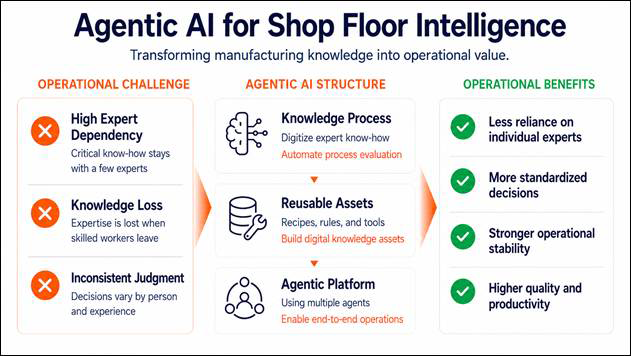
This creates a major challenge. As experienced workers retire or move to different roles, companies risk losing years of accumulated know-how. In many plants, critical knowledge about process conditions, troubleshooting, quality judgment, and equipment behavior is not fully documented. It often exists as tacit knowledge held by a small number of experts.
Vertical AI can help address this issue by turning field knowledge into reusable digital assets. By analyzing sensor data, work logs, inspection records, equipment data, and expert decision histories, AI can help structure operational knowledge into repeatable processes and decision logic.
The Rise of Agentic AI in Manufacturing
Another important trend is Agentic AI. While traditional AI tools often answer questions or provide recommendations, AI agents can support more active workflows. They can interpret data, follow defined processes, coordinate with other systems, and assist with specific tasks.
In manufacturing, AI agents can be applied across production, quality, maintenance, and process operations. For example, a process operation agent may help analyze abnormal conditions and recommend response actions. A quality agent may support inspection by learning from historical defect patterns and expert judgment. A maintenance agent may monitor equipment behavior and identify early signs of failure.
The value of these agents increases when they are connected through an integrated platform. Instead of operating as isolated tools, multiple agents can work together across different functions. This allows companies to move beyond single-task automation and toward more connected, end-to-end operational intelligence.
Turning Expert Knowledge into Digital Assets
One of the most practical applications of Vertical AI is the preservation of skilled worker knowledge. In many plants, experienced workers know how to adjust operations based on subtle signals: equipment sounds, process trends, visual inspection patterns, or unusual combinations of operating conditions.
AI can help capture and standardize this knowledge. Expert workflows, judgment criteria, and response patterns can be analyzed and converted into digital recipes, rules, tools, or knowledge assets. These assets can then be reused across teams, shifts, and sites.
This does not mean replacing skilled workers. Rather, it allows their expertise to be shared more broadly and applied more consistently. It also helps inexperienced workers make better decisions by giving them access to structured operational guidance.
Industry leaders, including SK AX and many other forward-looking manufacturers, are collaborating across factory and warehouse facilities to develop sector-specific AI frameworks. The goal is to convert raw field expertise and operational data into reusable digital assets, deploying AI not as a generic overlay, but as practical intelligence natively embedded into factory workflows.
Applications Across Quality, Maintenance, and R&D
Quality inspection is an area where Vertical AI can create strong value. By combining high-resolution vision systems with AI models trained on defect patterns and inspection history, manufacturers can reduce variation caused by individual inspector experience. It helps to improve consistency, reduce rework, and enforce more consistent quality standards.
Maintenance is another important area. AI can analyze equipment data to detect unusual patterns before they become failures. This helps companies move from reactive maintenance to predictive maintenance, reducing unplanned downtime and improving equipment reliability.
Vertical AI can also support R&D. In material development, AI-based property prediction can help estimate physical or chemical characteristics before actual synthesis or testing. This can reduce trial-and-error cycles, shorten development time, and help researchers identify promising candidate materials more efficiently.
Security and Governance Matter
As AI becomes more connected to manufacturing operations, security and governance become critical. Production data, process conditions, quality standards, cost information, and equipment data are sensitive business assets. If this data is exposed or misused, it can create operational and competitive risks.
For this reason, manufacturing AI systems should be designed with strong access control, audit logs, user permissions, and compliance requirements from the beginning. AI agents should only access the data they are authorized to use, and their actions should be traceable.
The Future: Practical, Industry-Specific AI
The future of AI in manufacturing will not be defined by general intelligence alone. It will be defined by how effectively AI can solve specific industrial problems. Manufacturers will increasingly look for AI that can understand their processes, support their workers, improve decision-making, and deliver measurable business outcomes.
Vertical AI and Agentic AI represent this shift. They help manufacturers move from experimentation to practical adoption by connecting AI with real operational workflows. As industry evolves, the most valuable AI solutions will be those that combine domain expertise, reliable data, secure governance, and a clear understanding of how work is done on the factory floor.
The next phase of manufacturing AI will likely require a specialized, industry-specific approach. As noted by SK AX, the primary challenge moving forward is how to successfully blend AI capabilities with raw domain expertise into practical, scalable institutional intelligence.