


Hazardous Waste Storage Facility: Regulatory Requirements and Design Guidelines
Guest blog by MHI member RackUSA
A common issue in hazardous waste management is complying with EPA requirements only on paper, which often leads to operational failures such as undetected leaks, uncontained spills, and stagnant waste. A safe, traceable, and sustainable storage facility relies on strategic infrastructure decisions made during the design phase, rather than just good intentions.
The Physical Conditions Required by Regulations for the Storage Area
To ensure proper management, EPA regulations mandate specific physical conditions for these accumulation areas. The storage zone must be isolated from production and administrative spaces, featuring impermeable, crack-free floors with secondary containment, non-flammable walls, and adequate ventilation to prevent dangerous vapor buildup.
Furthermore, the facility must guarantee sufficient aisle space for personnel and emergency response. Strict compliance also requires clear signage, precise container labeling, including specific hazards and accumulation dates, unobstructed access to safety equipment, and a complete absence of direct drain connections.Packaging is also a critical part of waste management. Each container must be compatible with the substance it holds, kept closed (except when actively adding or removing waste), and in good condition.
These are the baseline requirements for any temporary accumulation area. What the regulations do not explicitly specify is exactly how the storage systems should be organized within that physical space.
Why the Rack System is a Safety Decision, Not Just a Storage One
The rack dictates how the operator accesses each storage position. It defines how long they remain exposed during every hazardous waste handling maneuver. It defines how quickly they can exit the area if an incident occurs.
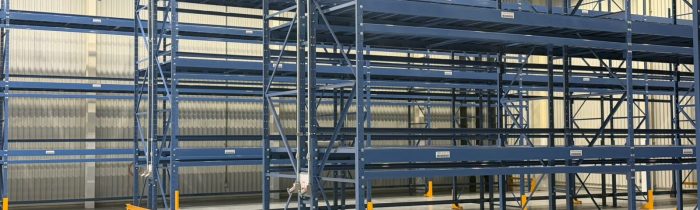
Selective racking is the most appropriate foundational system for hazardous waste management. It allows direct, individual access to each position without the need to move other materials. If a drum develops a leak, the operator can remove it immediately, perform the required inspections directly from the aisle and identify a problem before it escalates. In practice, that is the difference between a contained incident and one with a real environmental and financial impact.
The Accessories That Turn a Standard Rack into a Safe Hazardous Waste System
Choosing the right rack is the first step. The accessories determine whether that system responds well to the real-world conditions of hazardous materials and waste storage.
• Wire decking: Rather than trapping spilled liquids, wire decking directs them downwards to the floor-level containment sump. This enables rapid leak detection directly from the aisle.
• Solid Surface Decking: Located at the base of the rack, these form your secondary containment system. It is vital that their capacity is calculated according to EPA regulations to safely accommodate a worst-case scenario.
• Column protectors: Often mistakenly treated as optional, column protectors are critical in areas with forklift traffic. They absorb impacts and prevent the destabilization of racks holding corrosive, ignitable, or highly hazardous substances.
• Pallet stops: These mechanisms prevent a palletized container from being accidentally pushed past its designated position. They are a low-cost but highly critical investment.
How to Design the Internal Layout for Proper Hazard Segregation
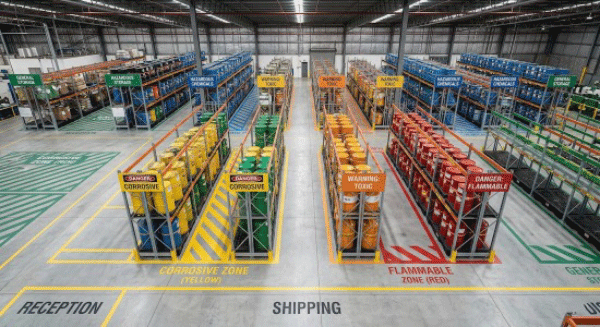
Regulatory compliance requires translating hazard segregation rules into concrete physical zones rather than relying solely on signage. Each EPA hazard class must have its own dedicated rack module, physically separated by aisles to prevent dangerous reactions between incompatible wastes—such as ignitables and oxidizers—as mandated by OSHA and the EPA.
Instead of prioritizing storage capacity, aisle widths must be determined by safety and emergency requirements. The EPA explicitly demands “adequate aisle space” to ensure the unobstructed movement of personnel, safe maneuvering, and immediate access for emergency equipment.
Furthermore, the layout should position the highest-risk materials away from main entrances while maintaining clear evacuation routes, leaving lower-risk wastes closer to access points. Finally, racks storing corrosive wastes must utilize anti-corrosion coatings, as acidic vapors can invisibly degrade standard steel and lead to unexpected structural failure.
The Difference Between a Space That Simply Complies and One That Truly Works
A hazardous waste accumulation area that complies with the EPA covers the legal minimum. One that is also internally well-designed protects human health, facilitates the traceability required by regulations, and reduces the probability that a minor hazardous waste incident escalates into a problem with a real impact on the facility, the environment, and the business’s operational continuity.
Designing that space requires understanding the hazardous wastes generated, their frequency, their EPA/DOT incompatibilities, and the physical conditions of the site. It is not a decision that can be solved by simply picking a rack from a catalog.

