


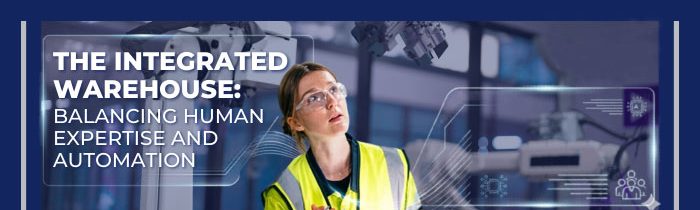
The Integrated Warehouse: Balancing Human Expertise and Automation
Guest blog from New Age Industrial Corp, MHI member company and MHI EASE Industry Group member
There is a common misconception in the supply chain world that the road to efficiency is an “all-or-nothing” choice—a cold, steel-and-wire competition between robots and humans. While we often see headlines about the rise of the “dark warehouse,” the reality on the warehouse floor is much more collaborative, vibrant, and, frankly, more human. The most productive modern warehouses aren’t replacing people with machines; they are building hybrid environments. This is the “Best of Both Worlds” approach: using technology to amplify human potential rather than sideline it.
1. Definition: Collaboration, Not Competition
In a hybrid setup, the division of labor is based on individual strengths. Hybrid systems offload the “3 D” tasks—those that are Dull, Dirty, or Dangerous—to automation, allowing humans to focus on high-value roles.
· Amplifying Potential: Autonomous Mobile Robots (AMRs) excel at repetitive, high-density hauls and covering long distances across the warehouse floor every day. This frees up human team members to do what they do best: exception management, complex picking, and critical quality control.
· Flexibility & Scalability: Unlike rigid, fully automated systems, hybrid setups allow companies to gradually adopt technology. You can scale up your robot fleet during a peak holiday season and scale back during the summer, ensuring your operation remains agile without the risk of a multi-million dollar “all-in” investment.
2. Key Components of the Hybrid Workflow
To create a truly streamlined flow, technology and people have to speak the same language. This integration usually relies on a few key building blocks:
· Goods-to-Person (GTP) Systems: These solutions bring inventory directly to a stationary operator. By reducing physical strain and eliminating the need to rush through transit, this shift allows workers to remain fresh and focused on the task at hand, which naturally improves order accuracy and reduces errors.
· Intelligent Software (WMS): Modern software serves as the orchestration layer. It directs the flow of the facility by assigning high-density tasks to automation while routing complex orders to human pickers, keeping the entire operation in a state of continuous, balanced motion.
· Precision-Engineered Hardware: For a robot to be efficient, the physical equipment it interacts with—including carts, pallets, and trays—must be consistent and durable. Lightweight materials like aluminum are ideal because they preserve the battery life of robotic bases while remaining easy for human workers to maneuver. Furthermore, precision-welded aluminum provides the dimensional stability required for sensors and vision systems to track equipment with 100% accuracy.
3. The Tangible Benefits: Solving Real-World Challenges
The shift toward a hybrid model isn’t just about high-tech gadgets; it’s about solving real-world business challenges and improving the bottom line.
· Rapid ROI and Lower CapEx: Hybrid environments allow firms to start small. With models like Robots-as-a-Service (RaaS), companies can avoid massive upfront costs, making automation accessible to mid-sized operations.
· Increased Productivity & Payload: Aluminum equipment is roughly one-third the weight of steel, which reduces “dead weight” and reallocates that capacity to the actual product. This allows managers to calculate higher weight-to-payload ratios for their fleets, moving more product per charge.
· Ergonomic Safety: Members of MHI’s EASE (Ergonomic Assist Systems & Equipment) group, including New Age Industrial, advocate for “save-a-step” strategies. By using robots for long-distance travel, workers stay fresh and focused, drastically reducing the risk of repetitive motion injuries.
· Specialized Environment Compliance: In cold storage or pharmaceutical automation, aluminum actually increases in tensile strength as temperatures drop. Combined with its natural fire resistance—helping facilities comply with NFPA 1 standards—it provides a safety-first foundation for Automated Storage and Retrieval Systems (AS/RS).
4. Navigating Implementation Challenges
Of course, building a shared workspace between humans and robots isn’t without its growing pains. Success requires intentional planning.
· Integration Complexity: Making new robotics communicate with legacy systems takes careful technical alignment to ensure data flows as smoothly as the physical goods.
· Maintenance & Support: To avoid downtime, facilities must plan for regular maintenance. Opting for bolt-on component designs rather than permanent welds allows for rapid part replacement, ensuring the human-machine handoff never breaks down.
The Human Strategy for Technical Change
While the technology is impressive, the success of a hybrid environment ultimately rests on the people who lead and operate it. A streamlined workflow isn’t just about software talking to hardware; it’s about transparent communication between leadership and the floor. By involving team members early in the process—valuing their feedback on where they see the most friction—companies can build a culture of trust. When the workforce sees automation as a tool that respects their time and physical well-being, the transition from a traditional warehouse to a modern hybrid facility becomes a shared victory rather than a source of stress.
The Bottom Line: Better Together
A smart warehouse isn’t one that removes the human element; it’s one that elevates it. When we pair the tireless precision of automation with the ingenuity and adaptability of people, we create a workflow that is faster, safer, and more resilient. The future of the supply chain isn’t just about better machines; it’s about shifting the focus away from repetitive and strenuous manual labor and toward how well we work together to build a more sustainable and productive industry.

