



WHY WHY MANUFACTURING AI SHOULD START WITH OPERATIONAL LOSS
Guest blog from MHI member SK AX USA
Manufacturers have traditionally improved operations through equipment upgrades, automation, KPI reviews, and the experience of plant managers and engineers. These approaches remain important, but they are becoming harder to rely on alone.
Today’s production environments are influenced by many connected factors, including equipment conditions, material quality, production schedules, labor availability, energy costs, and supply chain volatility. A decline in productivity or quality is rarely caused by one isolated issue.
AI offers a more data-driven way to identify these complex losses, determine where improvement efforts should begin, and connect operational results to measurable business value.
Manufacturing Losses Are Becoming More Complex
Traditional operational improvement often begins after a problem has already occurred. Teams review historical KPIs, interview plant personnel, and rely on experienced experts to determine the cause. As manufacturing systems become more connected and operating conditions change more frequently, the causes of loss are increasingly difficult to identify through periodic reviews alone.
AI can analyze production data, equipment signals, quality records, maintenance history, and energy consumption together, allowing manufacturers to detect abnormal patterns earlier and identify relationships that may be difficult to recognize through manual analysis. The role of AI is not to replace experienced workers, but to help them analyze more variables, identify improvement opportunities faster, and make quicker and more consistent decisions.
Manufacturing specialists are increasingly combining AI analysis with factory field operation know-how. This combination allows data to reveal patterns, and experienced plant personnel to provide operational context to turn these patterns into operational improvement actions.
Start with the Largest Operational Loss, Not with the Specific Technology
When adopting AI, manufacturers often begin by asking which technology or model they should use. A more practical question is:
Where is the operation losing the most value?
These major loss areas—often referred to as Top Losses—may include equipment downtime, yield loss, production bottlenecks, material waste, maintenance costs, and energy inefficiency.
A sophisticated AI model may create limited value if it addresses a minor problem. A relatively simple use case can generate stronger results when it targets a large and recurring loss.
For example, equipment downtime affects more than machine availability. It can also reduce production capacity, disrupt schedules, increase labor costs, and delay customer deliveries. Quality variation may lead to scrap, rework, longer lead times, and additional inspection.
For this reason, manufacturers should begin with a clear baseline, identify the largest source of operational loss, and understand how that loss impacts financial performance.
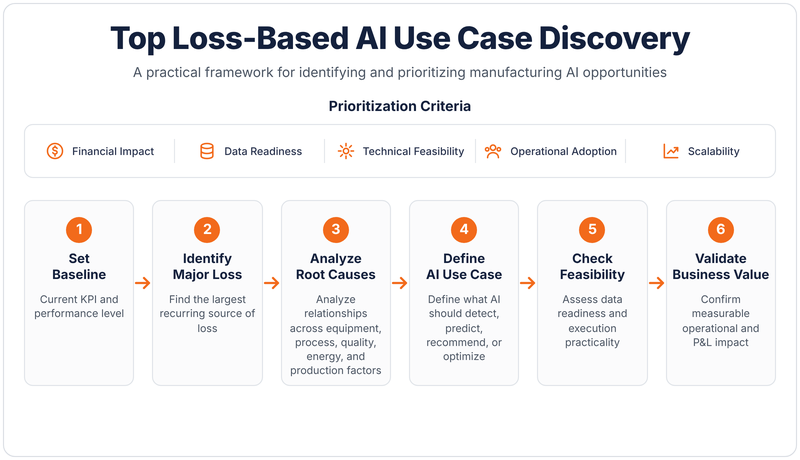
Use cases should then be prioritized based on financial impact, data readiness, technical feasibility, operational adoption, and scalability.
This loss-first approach reflects a broader lesson from manufacturing transformation initiatives: AI creates the most value when it is applied to a clearly defined operational problem rather than introduced as a stand-alone technology. In its manufacturing work, SK AX applies this principle by connecting operational data, field expertise, and measurable improvement objectives from the beginning of an initiative.
Move Beyond the PoC and Track Value in the P&L
Many manufacturing AI initiatives stop after successful proof of concept. The model may demonstrate strong technical performance, but the result does not always translate into sustained operational value.
A PoC should therefore be treated as the beginning of the improvement process—not the outcome.
Each use case should define:
• A target KPI and current baseline
• An expected level of improvement
• A clear operational owner
• A method for calculating financial impact
• A process for continuously tracking results
For example, predictive maintenance should not be measured only by model accuracy. Its impact should also be assessed through reduced downtime, lower maintenance costs, increased equipment availability, and improved production output.
This continuous connection between AI performance, operational KPIs, and financial outcomes is often described as AI Value Tracking.
Sustainable results also require coordination across leadership, plant operations, data and AI teams, and finance. Plant teams act on recommendations, data teams maintain the models and pipelines, and finance validates whether the improvement is reflected in actual business results.
Organizations that work across manufacturing operations, digital systems, and AI, are helping develop frameworks that connect these functions. The objective is not simply to complete more AI pilots, but to create a repeatable process in which operational improvements are validated and continuously reflected in business performance.
From AI Experiments to Repeatable Improvement
The value of manufacturing AI is not determined by how many models or pilots a company develops.
It depends on whether the organization can identify its most important losses, apply AI to practical operating decisions, and repeatedly convert improvement results into measurable P&L impact.
The next stage of manufacturing AI will therefore be less about isolated technology experiments—but more about creating a repeatable system for finding losses, executing improvements, and sustaining business value.

